






 1800 278 462
Reassessing the Role of OCS in Asthma
For decades, oral corticosteroids (OCS) have been a cornerstone in the management of acute asthma exacerbations.1,2 Even with the advent of inhaled corticosteroid, which achieved massive reduction in risk of severe asthma since its arrival, OCS use in asthma has remained common.3 However, emerging evidence reveals that even low cumulative exposure can significantly increase the risk of irreversible adverse health outcomes.3,4
OCS will continue to play a critical role in specific clinical situations. However, advances in readily available treatment and management approaches, coupled with new insights into threshold dose risk, make this an ideal time to reassess their role in asthma care.3–6
OCS and Long-Term Health Outcomes
-
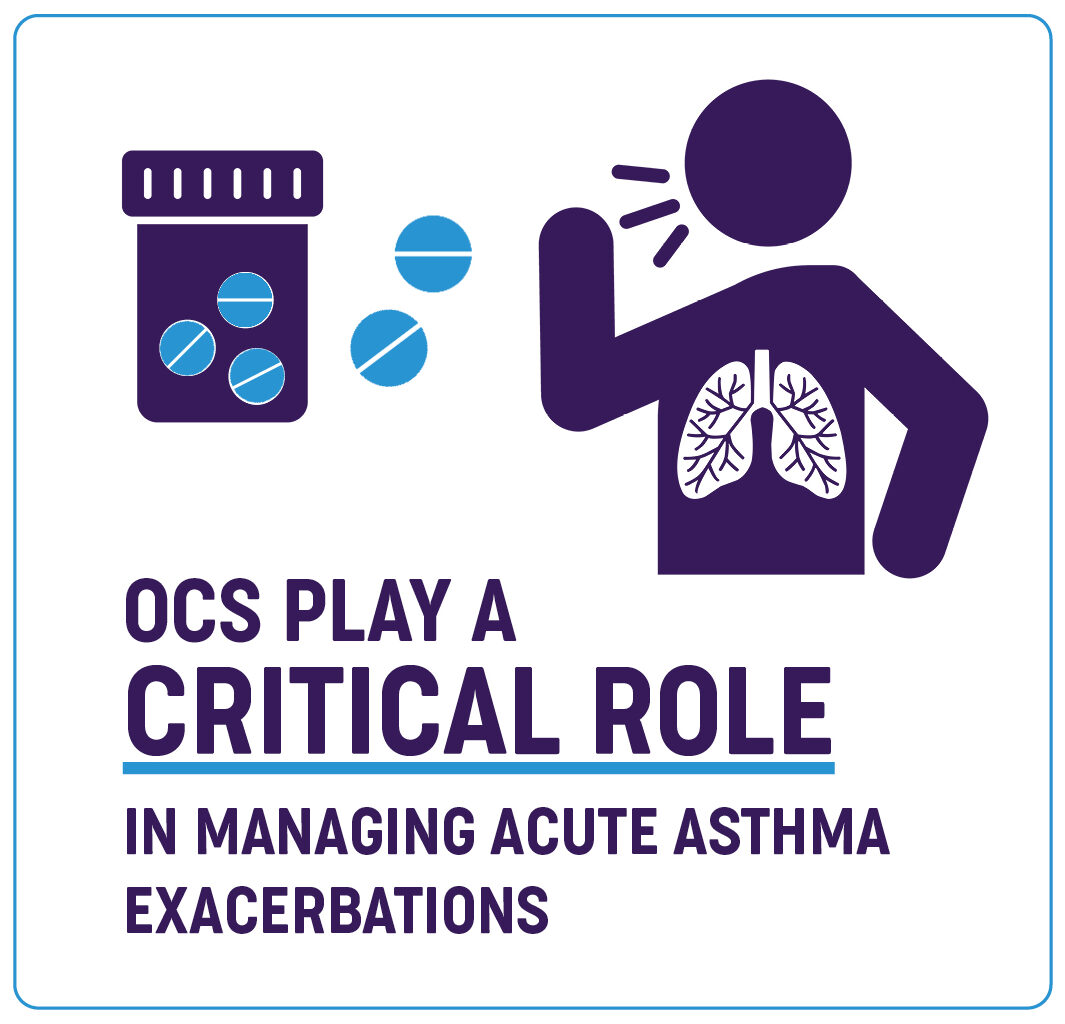
Appropriate use of OCS plays a critical role in managing acute asthma exacerbations
- OCS will continue to play a critical role in managing some acute asthma exacerbations. However, advances in readily available treatment and management approaches, coupled with new insights into threshold dose risk, make this an ideal time to reassess their role in asthma care.3–6
- For decades, OCS have been a cornerstone in the management of acute asthma exacerbations, with proven efficacy in reducing hospital admissions and asthma relapse rates.1,7
- Guidelines such as the Global Initiative for Asthma (GINA) and the Asthma Australia Handbook recommend OCS for severe exacerbations.5,8
- Evidence shows their effectiveness in reducing airway inflammation and hyperresponsiveness.1,5,9
- Short courses, typically used as rescue therapy during acute asthma attacks, provide rapid improvement in lung function within hours of administration.1,5
- Long-term courses have been prescribed as a last resort in cases of severe, refractory asthma, when other treatments have failed to achieve control.10
- While a short course of OCS may be necessary during asthma exacerbations, GINA states that maintenance OCS should be a last resort due to the associated adverse effects.5
-
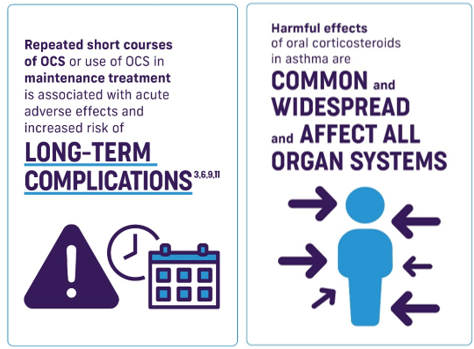
OCS are associated with short- and long-term side effects
- Low cumulative exposure to OCS (as little as 500mg in a lifetime) is associated with a significant risk of irreversible adverse health outcomes.9
- Short-term adverse effects include dyspepsia, insomnia, fluid retention, venous thromboembolism and infection, which can occur even at low doses.3,10-12,14
- Long-term use has widespread effects on multiple organ systems, such as the cardiovascular, skeletal, and endocrine systems, and causes weight gain, deterioration of bone density, and systemic suppression of inflammation and immune responses.10,13–15
- Over half of people with severe asthma treated with regular OCS* have at least three steroid-related comorbidities.16
- Compared with matched controls without any OCS exposure, people prescribed OCS show significantly higher incidence of developing a range of adverse outcomes including gastro-oesophageal reflux disease, obesity, diabetes, osteoporosis/fracture (hazard ratio [HR] 3.11), pneumonia (HR 2.68), cardio/cerebrovascular disease (HR 1.53), cataracts (HR 1.50), sleep apnoea, (HR 1.40) and renal impairment (HR 1.36).3
*Regular OCS is defined as four or more OCS prescriptions per year in each of two consecutive years.
-
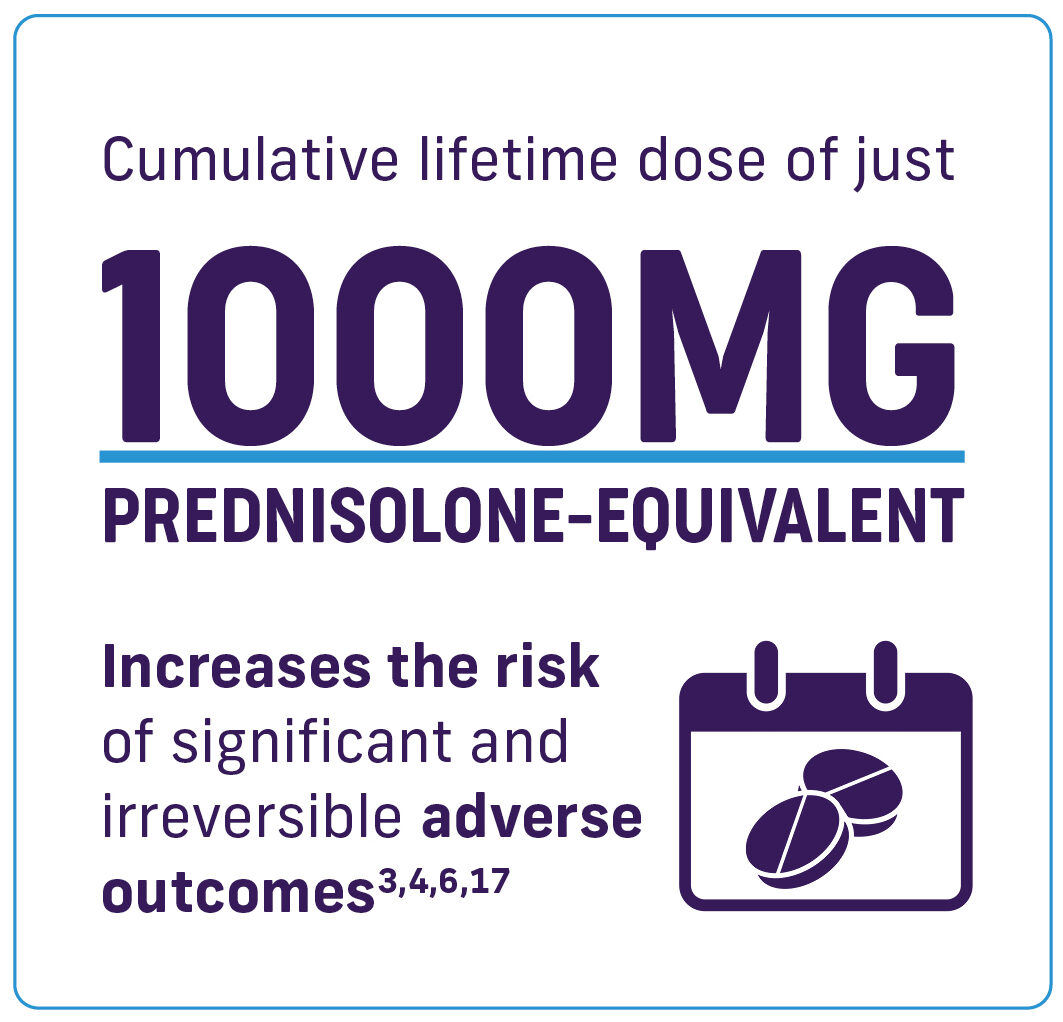
A cumulative lifetime dose of just 1000mg prednisolone-equivalent increases the risk of significant and irreversible adverse outcomes
- A cumulative lifetime dose of 1000 mg prednisolone-equivalent is linked to a significantly higher risk of severe adverse outcomes, including osteoporosis, hypertension, and type 2 diabetes, compared to individuals without such exposure.3
- Data from the Australasian Severe Asthma Registry (2013–2021) showed that a cumulative dose of just 500 mg prednisolone-equivalent was significantly associated with increased comorbidities, including gastro-oesophageal reflux disease, obstructive sleep apnoea, obesity, diabetes, and osteoporosis.4
- A clear dose–response relationship exists between cumulative OCS exposure and adverse outcomes. For every year with ≥4 prescriptions, there is a 30% increased risk of getting AEs.3,11,17
-
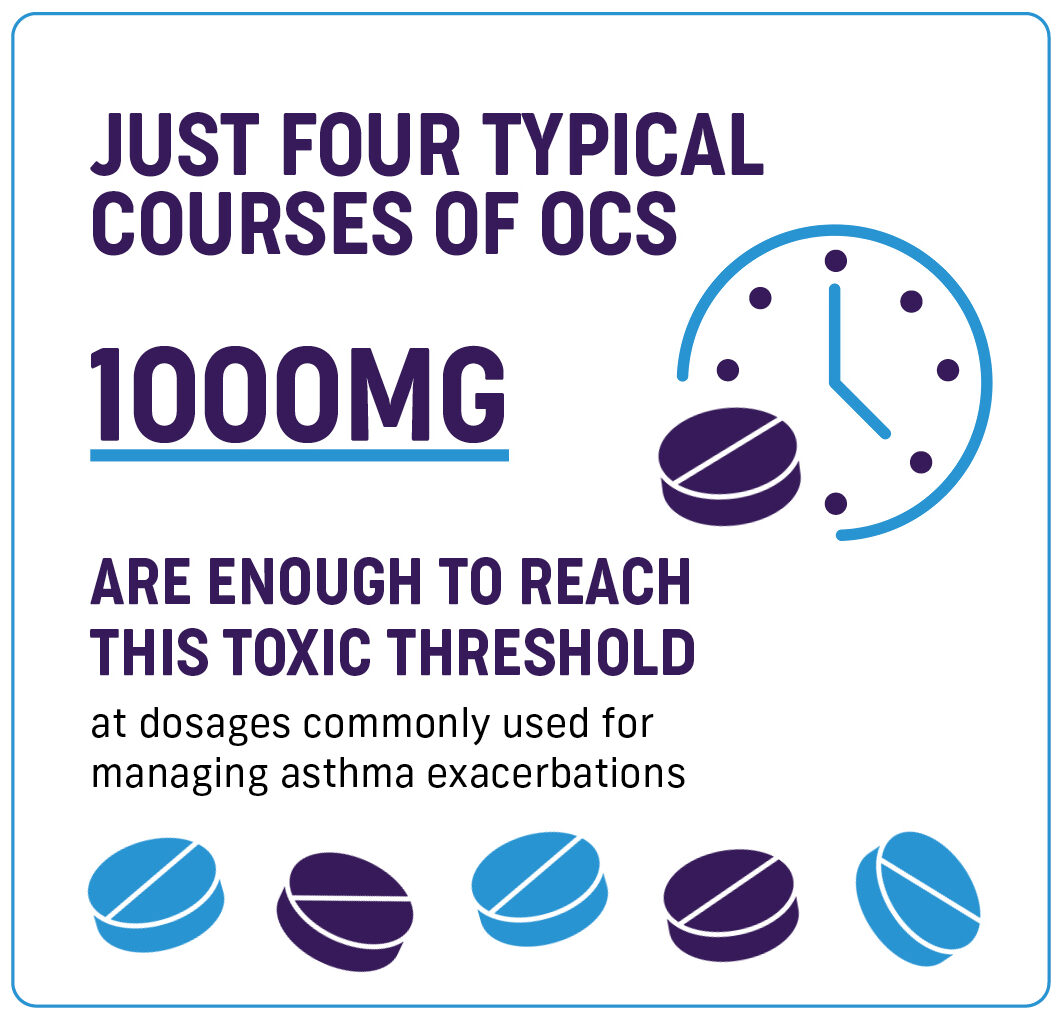
Just four typical courses of OCS are enough to reach this toxic threshold
- A typical course of OCS for adults is 250 mg prednisolone-equivalent. A potentially toxic threshold dose (1000 mg prednisolone-equivalent) is reached with lifetime exposure to just four OCS courses of treatment at dosages typically used for management of asthma exacerbations.6
- A cumulative lifetime dose of 1000 mg prednisolone-equivalent is linked to a significantly higher risk of severe adverse outcomes, including osteoporosis, hypertension, and type 2 diabetes, compared to individuals without such exposure.3
-
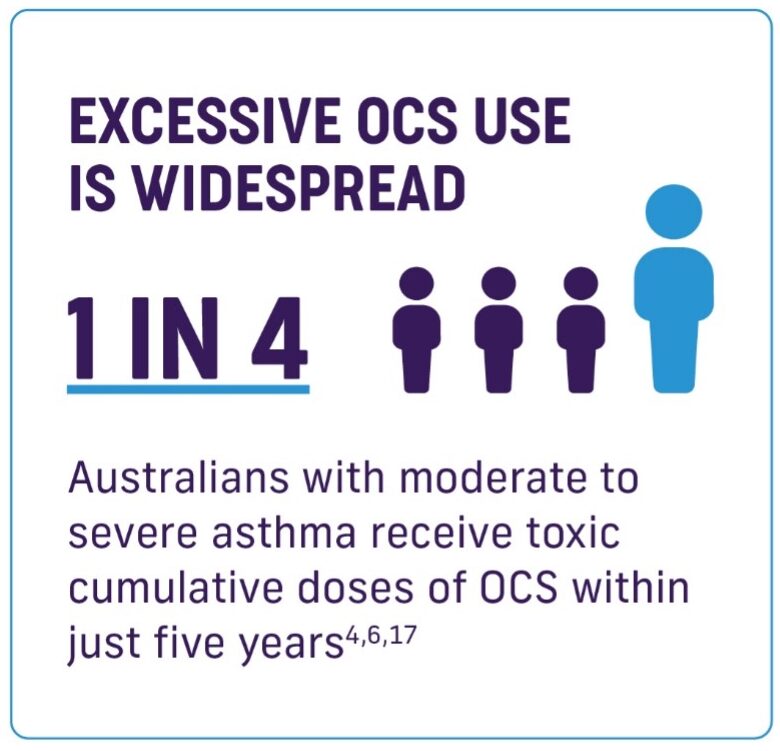
Excessive OCS use is widespread
- In an Australian real-world study of 124,011 people aged over 12 years with moderate to severe asthma, 52% were prescribed oral corticosteroids over a five-year period (2014–2018), and 27.9% of these individuals received a cumulative lifetime dose (≥1000 mg prednisolone-equivalent) that exceeded the toxicity threshold.18
- This same study stratified subjects according to inhaled corticosteroid (ICS) use and found that among the 4,633 people prescribed high dose ICS, 50% were poorly adherent to their prescription.18
- In another large-scale study of 1,851,129 Australians with asthma, 45,117 (10%) of those with difficult-to-treat asthma were prescribed OCS at a toxic cumulative dose within just six months.19
- For patients with mild or moderate asthma, effective control can be achieved with a personalised approach to management by combining inhaled therapies and non-systemic treatments and increasing treatment adherence.19
Content based on an expert position statement commissioned by the Thoracic Society of Australia and New Zealand (TSANZ), published in Respirology.
Blakey, J., et al. 2021. Oral corticosteroids stewardship for asthma. Respirology, 26, 1112–1130. https://doi.org/10.1111/resp.14147
Suggested Content
Hear from clinical experts talk about how to apply OCS Stewardship principles in practice, in adult and paediatric populations in short-form FAQ-style video responses. Learn practical tips for real-world clinical practice implementation of asthma care to minimise OCS over-use.
Implementing Responsible OCS Use
View the recording of the TSANZ webinar, Oral corticosteroid stewardship in asthma. Chaired by Prof Vanessa McDonald, the agenda combined expert-led presentations from respiratory specialists Prof John Blakey and Dr Shivanthan Shanthikumar with a diverse panel of voices, including Prof Desley Hegney offering crucial insights from the asthma consumer perspective, and Prof Nick Zwar representing the primary care viewpoint.
Dive into the subject with an accredited online learning module, Oral corticosteroids in asthma: navigating between benefits and harms, available through our education delivery partner ThinkGP.
References
- Alangari A. Corticosteroids in the treatment of acute asthma. Annals of Thoracic Medicine 2014;9(4):187-192.
- British Thoracic Society. Inhaled corticosteroids compared with oral prednisone in patients starting long-term corticosteroid therapy for asthma. The Lancet 1975;306(7933):469-473. https://doi.org/10.1016/S0140-6736(75)90545-0
- Price DB, et al. Adverse outcomes from initiation of systemic corticosteroids for asthma: long-term observational study. Journal of Asthma and Allergy 2018;11:193-204. https://doi.org/10.2147/JAA.S176026
- Politis J, et al. Oral corticosteroid stewardship: key insights from the AUSTRALASIAN SEVERE ASTHMA REGISTRY. Internal Medicine Journal 2024;54(7):1136-1145. https://doi.org/10.1111/imj.16392
- Global Initiative for Asthma. Global Strategy for Asthma Management and Prevention, 2025. Updated May 2025. Available from: www.ginasthma.org
- Blakey J, et al. Oral corticosteroids stewardship for asthma in adults and adolescents: a position paper from the Thoracic Society of Australia and New Zealand. Respirology 2021;26(12):1112-1130. https://doi.org/10.1111/resp.14147
- Shefrin AE, Goldman RD. Use of dexamethasone and prednisone in acute asthma exacerbations in pediatric patients. Canadian Family Physician 2009;66:704-706.
- National Asthma Council Australia. (2025). Australian Asthma Handbook, The National Guidelines for Health Professionals. (Version 3.0). https://www.asthmahandbook.org.au/
- Bleecker ER, et al. Systematic literature review of systemic corticosteroid use for asthma management. American Journal of Respiratory and Critical Care Medicine 2020;201(3):276-293. https://doi.org/10.1164/rccm.201904-0903SO
- Gaga M, Zervas E. Oral steroids in asthma: a double-edged sword. European Respiratory Journal 2019;54(5):1902034. https://doi.org/10.1183/13993003.02034-2019
- Sullivan PW, et al. Oral corticosteroid exposure and adverse effects in asthmatic patients. Journal of Allergy and Clinical Immunology 2017;141(1):110-116.e7. https://doi.org/10.1016/j.jaci.2017.04.009
- Liu D, et al. A practical guide to the monitoring and management of the complications of systemic corticosteroid therapy. Allergy, Asthma & Clinical Immunology 2013;9(1):30. https://doi.org/10.1186/1710-1492-9-30
- Iribarren C, et al. Adult asthma and risk of coronary heart disease, cerebrovascular disease, and heart failure: a prospective study of 2 matched cohorts. American Journal of Epidemiology 2012;176(11):1014-1024. https://doi.org/10.1093/aje/kws181
- Zazzali JL, et al. Risk of corticosteroid-related adverse events in asthma patients with high oral corticosteroid use. Allergy and Asthma Proceedings 2015;36(4):268-274. https://doi.org/10.2500/aap.2015.36.3863
- Zeiger RS, et al. Burden of chronic oral corticosteroid use by adults with persistent asthma. The Journal of Allergy and Clinical Immunology: In Practice 2017;5(4):1050-1060.e9. https://doi.org/10.1016/j.jaip.2016.12.023
- Sweeney J, et al. Comorbidity in severe asthma requiring systemic corticosteroid therapy: cross-sectional data from the Optimum Patient Care Research Database and the British Thoracic Difficult Asthma Registry. Thorax 2016;71(4):339-346. https://doi.org/10.1136/thoraxjnl-2015-207630
- Suehs CM, et al. Expert consensus on the tapering of oral corticosteroids for the treatment of asthma. A Delphi study. American Journal of Respiratory and Critical Care Medicine 2021;203(7):871-881. https://doi.org/10.1164/rccm.202007-2721OC
- Hew M, et al. Cumulative dispensing of high oral corticosteroid doses for treating asthma in Australia. Medical Journal of Australia 2020;213(7):316-320. https://doi.org/10.5694/mja2.50758
- Wark PAB, et al. Regional variation in prevalence of difficult-to-treat asthma and oral corticosteroid use for patients in Australia: heat map analysis. Journal of Asthma 2023;60(4):727-736. https://doi.org/10.1080/02770903.2022.2093217
Information and materials developed for the Oral Corticosteroid Stewardship Project are developed independently by Asthma Australia, with support from the Centre of Excellence in Treatable Traits, and reviewed by our Medical Advisor. In 2024, this work was made possible by unrestricted grant funding received from Chiesi Australia, GSK and Sanofi.

Publication date: October 2025
Author: Asthma Australia