





 1800 278 462
Asthma affects women differently.
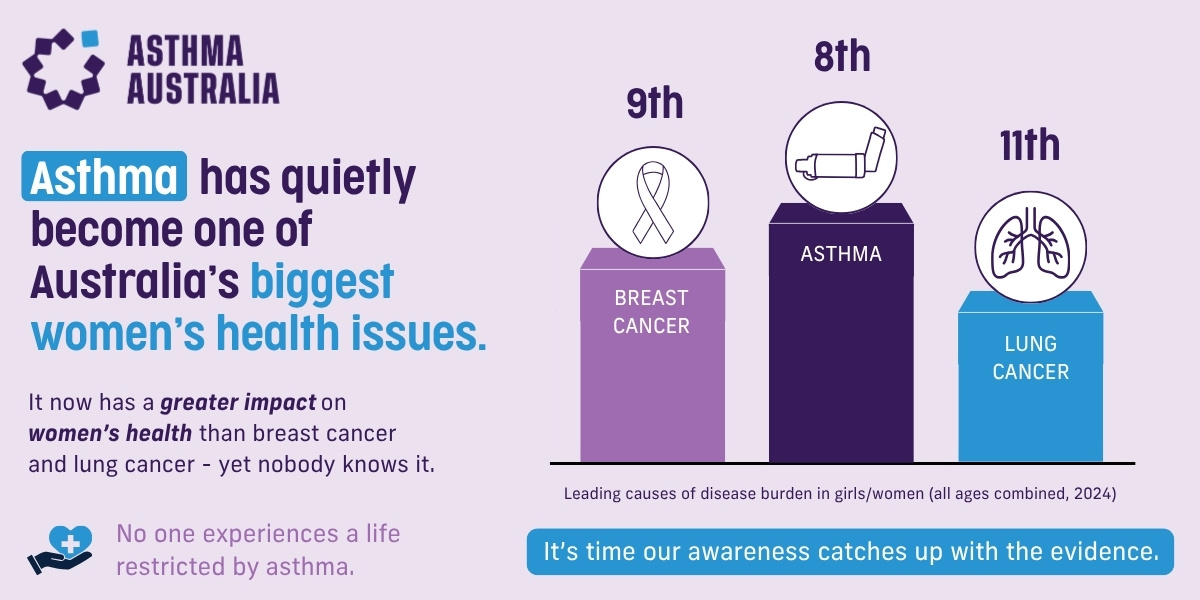
Asthma isn’t just common. It is one of the biggest health issues affecting Australian girls and women. In fact, asthma now causes a greater burden of disease in girls/women than breast cancer and lung cancer.3 Most Australians would never guess that—and that’s exactly the problem.
Hormonal changes during puberty, pregnancy, perimenopause and menopause can affect asthma symptoms and control.
- Understand your risk
- Learn how hormones affect asthma
- Get support for every stage of life
Concerned about your asthma? Make a plan to talk to your doctor about your asthma with an asthma review. Our Asthma Check-In tool guides you through simple questions about what you want to ask your doctor about your symptoms, medicines and recent flare‑ups, it then pulls everything together into one easy‑to‑read summary.
It’s a quick, practical way to feel more prepared and confident about your asthma care.

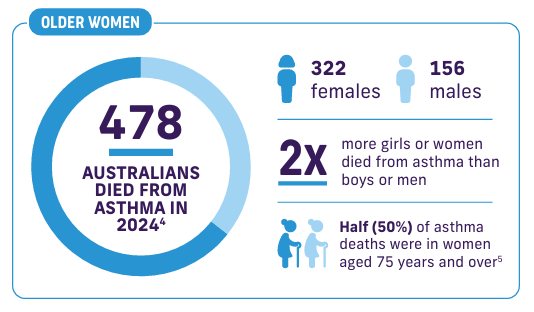
WOMEN ARE MORE LIKELY TO DIE FROM ASTHMA
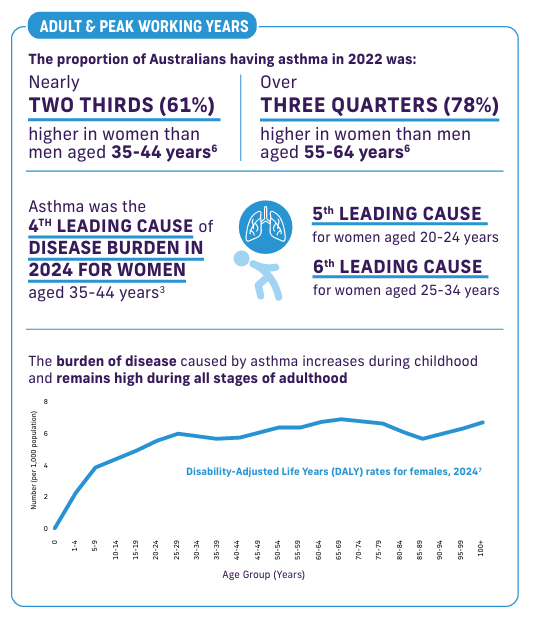
From childhood through to older age, girls and women carry a disproportionate burden of asthma, with higher prevalence after puberty, greater hospitalisation rates across adulthood, and more than twice the number of deaths compared to men4,6,8.
ASTHMA IS THE 8TH LEADING CAUSE OF DISEASE BURDEN IN GIRLS/WOMEN
“Disease burden” is a term used to show how much a health problem affects someone’s life – both how they feel day to day and how long they live.
When combining all ages, asthma was the 8th leading cause of disease burden in girls/women in 2024. And the impact of asthma on girls/women is getting worse, with a disease burden increasing by 11% between 2011 and 2024 (after adjusting for age)3.

For First Nations girls/women, asthma was the 5th leading cause of disease burden in 2022, ranking higher than type 2 diabetes and lung cancer9.
WHY IS ASTHMA WORSE FOR WOMEN?
Hormonal shifts across the life course influence airway inflammation and asthma control. This includes menstruation, pregnancy, perimenopause and menopause. These impacts are often made worse by social and environmental factors. Factors which can compound risk and make asthma more difficult to manage. Yet these gender differences are often overlooked in the way asthma is diagnosed and managed.
Asthma in women is not a single-stage issue. It evolves across the life course, and at every stage, girls and women face greater burden than their male counterparts.
Learn more about research in this space.
CHILDHOOD ASTHMA
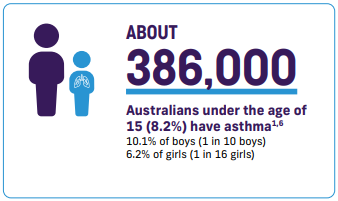
In childhood, asthma is the leading cause of disease burden for young girls aged 1-5 years and for school-age girls aged 5-141,3.
This burden continues to shape health, schooling and daily life from and throughout adolescence.
Around 5000 girls under 15 are hospitalised each year due to asthma2.
TEENAGERS AND YOUNG WOMEN
Even though asthma is more common in primary-school aged boys, after puberty the pattern shifts: asthma becomes more common in females than males6. Girls who already carry a high burden in childhood move into adolescence and adulthood with an even greater gendered risk. This shift is driven by hormonal changes that increase airway inflammation and asthma severity.
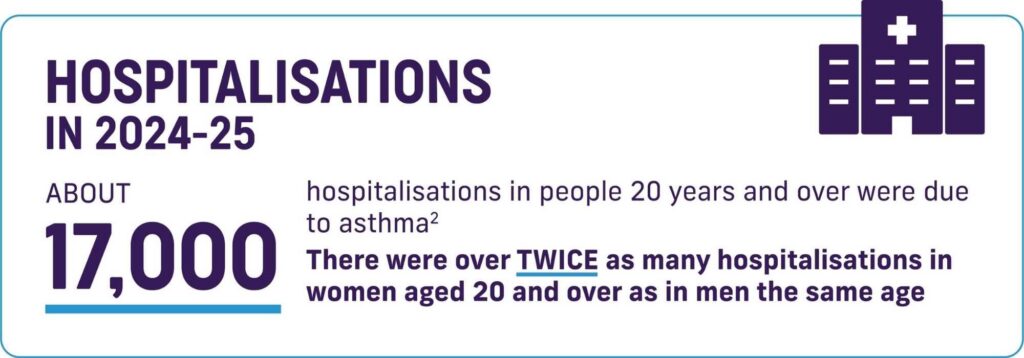
Girls and women are hospitalised at around twice the rate of boys and men in all age groups starting from age 158.
The teenage years are a key time for asthma care. Teens reach new age milestones that open up more treatment options. They also start taking on more responsibility for their own asthma. Peer pressure and wanting to feel “normal” can make asthma care harder. Supervision of daily preventer use often drops, and teens are expected to manage their medicines and symptoms on their own.
Read asthma guidelines for teenagers
For girls who have been managed within paediatric specialist services or tertiary children’s hospitals, this period also marks a critical transition in clinical care. Referral to the adult health system can disrupt established care coordination. It means saying goodbye to trusted care partners and follow up routines.
Without structured transition planning, this shift may compromise continuity of care, medicine use, and clinical oversight at a time when self-management expectations are increasing.
Asthma and Pregnancy
Asthma is one of the most common chronic conditions affecting pregnancy.
Hormones shift, your body is working harder, and you might notice your symptoms change or become more difficult to control. Because you’re breathing for yourself and your baby, keeping your asthma under control is very important.
Most daily preventer medicines are low risk in pregnancy and should be continued. Treat flare-ups early. Good asthma control helps make sure your baby gets the oxygen they need to grow.
If you’re pregnant or planning pregnancy, talk with your doctor about your asthma plan and learn more about asthma and pregnancy here.
ASTHMA AND PERIMENOPAUSE, MENOPAUSE, OR POST-MENOPAUSE
Asthma can place a heavy load on women through midlife. This is often strongest around perimenopause and menopause3. Social and environmental pressures can add to this. Many women in this stage of life are also caring for children, partners or ageing parents.
|
I often miss out on my asthma medicine because I make sure that my daughter has hers, and we can’t always afford both. – social media commenter |
Research on asthma, perimenopause and menopause is still growing. There is still a lot we do not fully understand. Many studies have gaps or mixed findings, especially when looking at how other health conditions may affect asthma at this time. Even so, newer research shows that hormonal changes in perimenopause and menopause can affect lung health and asthma symptoms.
WOMEN AND ASTHMA IN LATER LIFE
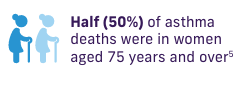
Asthma outcomes are worse for older women in Australia, who experience some of the highest rates of asthma illness and death. Women aged 75 and over account for nearly half of all asthma deaths5.
Asthma in older adults often presents differently. Sometimes it may appear more severe, while sometimes it is overlooked or misdiagnosed. Many older women also live with other chronic conditions. Other health concerns can complicate asthma management and make symptoms harder to recognise.
OUR ASTHMA AND WOMEN CAMPAIGNS

It’s time to put asthma on the Women’s Health agenda.
View She Needs to Breathe Campaign
ASTHMA QUESTIONS ANSWERED
Call our free information and support service to speak with an Asthma Educator. 1800 ASTHMA (1800 278 462) or email [email protected]
-
Frequently Asked Questions
Why does asthma affect women differently than men?
Hormonal changes throughout life can affect asthma symptoms and control. Changes during puberty, menstruation, pregnancy, perimenopause and menopause can increase airway inflammation and make asthma harder to manage for some women.
Are women more likely to have serious asthma attacks?
Yes. Women experience higher rates of asthma-related hospitalisations than men throughout adulthood and twice as many women die from asthma than men. Women also represent the majority of adults living with asthma in Australia.
Can hormones make asthma symptoms worse?
Yes. Hormonal fluctuations can trigger new asthma symptoms or make existing symptoms worse. Some women notice changes in their asthma during their menstrual cycle, pregnancy, perimenopause or menopause.
Can asthma change during pregnancy?
Yes. Pregnancy can affect asthma differently for each woman. Hormonal changes may improve, worsen or have no effect on asthma symptoms. It’s important to continue working with your healthcare professional to monitor and manage your asthma during pregnancy.
Does menopause affect asthma?
Hormonal changes during perimenopause and menopause can trigger asthma symptoms or make asthma more difficult to control. If you’ve noticed changes in your breathing during this stage of life, speak with your doctor about an asthma review.
Why is asthma more common in women after puberty?
While asthma is more common in boys during childhood, the pattern changes after puberty. Asthma becomes more common in females, partly due to hormonal changes that can influence airway inflammation and asthma control.
What are signs that my asthma may not be well controlled?
You should speak with your doctor if you experience symptoms more than twice a week, wake at night due to asthma, use your reliever inhaler frequently, or find that symptoms are interfering with your daily life. An asthma review can help ensure your treatment remains effective.
Should women have an Asthma Action Plan?
Yes. An Asthma Action Plan is a personalised guide developed with your doctor that explains how to manage your asthma every day and what to do if symptoms worsen. Having an up-to-date plan can help improve asthma control and reduce the risk of severe flare-ups.
How can I better manage asthma at different stages of life?
Regular asthma reviews, taking prescribed medications, using an up-to-date Asthma Action Plan, and understanding how hormonal changes may affect your symptoms can help you maintain good asthma control throughout life.
-
References
References
- AIHW. Health of children [cited 2026 Aug 21]. https://www.aihw.gov.au/reports/health-of-children
- Australian Institute of Health and Welfare (AIHW). Principal diagnosis data cubes. Separation statistics by principle diagnosis, Australia, 2023-24 and 2024-25 [cited 2026 Aug 19]. www.aihw.gov.au/reports/hospitals/principal-diagnosis-data-cubes/contents/summary
- AIHW. Australian Burden of Disease Study 2024 [ cited 2026 Feb 4]. www.aihw.gov.au/reports/burden-of-disease/australian-burden-of-disease-study-2024
- ABS. Causes of Death, Australia, data cubes 2024 [cited 2025 Nov 14]. www.abs.gov.au/statistics/health/causes-death/causes-death-australia/2024
- National Asthma Council Australia. Asthma Mortality Statistics 2024 [cited 2025 Nov 25]. www.nationalasthma.org.au/living-with-asthma/resources/health-professionals/infographics/asthma-mortality-statistics-2024
- Australian Bureau of Statistics (ABS). Asthma [cited 2026 Feb 3]. www.abs.gov.au/statistics/health/health-conditions-and-risks/asthma/latest-release
- Based on AIHW material, Australian Burden of Disease Study 2024, Figure 3.5 [cited 2026 Feb 4], https://www.aihw.gov.au/reports/burden-of-disease/australian-burden-of-disease-study-2024/contents/interactive-data-on-disease-burden/disease-injury-specific-summary, used under license CC-BY 4.0 https://creativecommons.org/licenses/by/4.0/
- AIHW. Asthma [cited 21 Aug 2026]. https://www.aihw.gov.au/reports/chronic-respiratory-conditions/asthma
- AIHW. First Nations Burden of Disease Study 2022 [cited 2026 Aug 25]. https://www.aihw.gov.au/reports/burden-of-disease/first-nations-burden-of-disease-study-2022/contents/interactive-data-on-disease-burden/leading-causes-of-disease-burden
Published: 26/08/2026