





 1800 278 462
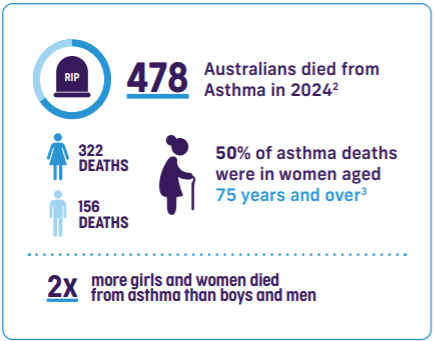
WOMEN ARE MORE LIKELY TO DIE FROM ASTHMA
From childhood through to older age, girls and women carry a disproportionate burden of asthma, with higher prevalence after puberty, greater hospitalisation rates across adulthood, and more than twice the number of deaths compared to men1, 2, 7. Learn how asthma affects older girls and women.
WHY IS ASTHMA WORSE FOR WOMEN?
Hormonal shifts across the life course influence airway inflammation and asthma control. This includes menstruation, pregnancy, perimenopause and menopause. These impacts are often made worse by social and environmental factors. Factors which can compound risk and make asthma more difficult to manage. Yet these gender differences are often overlooked in the way asthma is diagnosed and managed.
Asthma in women is not a single-stage issue. It evolves across the life course, and at every stage, girls and women face greater burden than their male counterparts.
CHILDHOOD
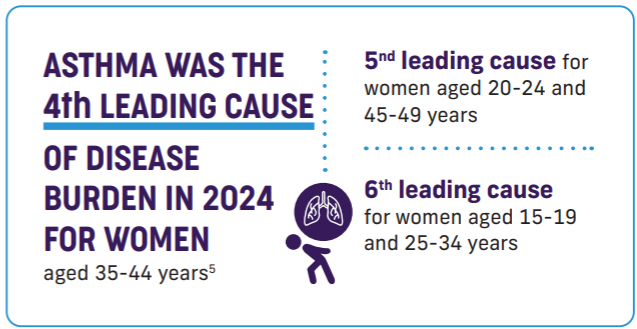
In childhood, asthma is the leading cause of disease burden in girls aged 1-9 years and the second leading cause of disease burden for older girls and adolescents (aged 10-14 years)5. This burden continues to shape health, schooling and daily life from and throughout adolescence.
“Disease burden” is a term used to show how much a health problem affects someone’s life – both how they feel day to day and how long they live.
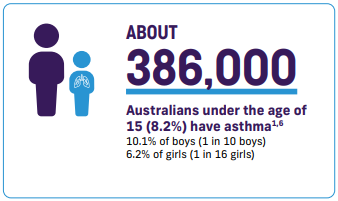
Around 5000 girls are hospitalised each year due to asthma4.
Learn more about asthma in kids
TEENAGERS AND YOUNG WOMEN
Even though asthma is more common in primary-school aged boys, after puberty the pattern shifts: asthma becomes more common in females than males 1. Girls who already carry a high burden in childhood move into adolescence and adulthood with an even greater gendered risk. This shift is driven by hormonal changes that increase airway inflammation and asthma severity.
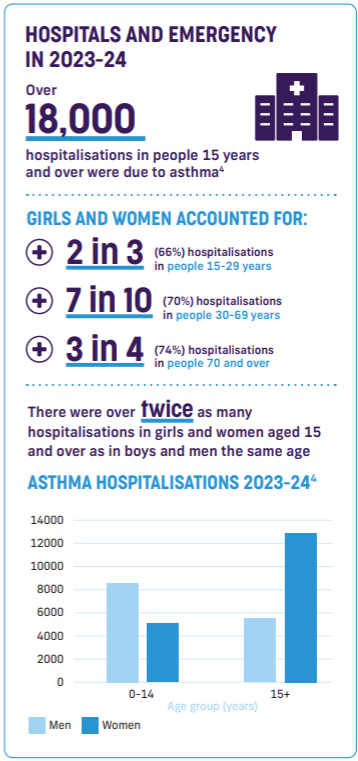
Girls and women are hospitalised at around twice the rate of boys and men in all age groups starting from age 15 7.
The teenage years are a key time for asthma care. Teens reach new age milestones that open up more treatment options. They also start taking on more responsibility for their own asthma. Peer pressure and wanting to feel “normal” can make asthma care harder. Supervision of daily preventer use often drops, and teens are expected to manage their medicines and symptoms on their own.
Learn more about asthma guidelines for teenager
For girls who have been managed within paediatric specialist services or tertiary children’s hospitals, this period also marks a critical transition in clinical care. Referral to the adult health system can disrupt established care coordination. It means saying goodbye to trusted care partners and follow up routines.
Without structured transition planning, this shift may compromise continuity of care, medicine use, and clinical oversight at a time when self-management expectations are increasing.
Learn more about teenager’s asthma care
Asthma and Pregnancy
Asthma is one of the most common chronic conditions affecting pregnancy.
Hormones shift, your body is working harder, and you might notice your symptoms change or become more difficult to control. Because you’re breathing for yourself and your baby, keeping your asthma under control is very important.
Most daily preventer medicines are low risk in pregnancy and should be continued. Treat flare-ups early. Good asthma control helps make sure your baby gets the oxygen they need to grow.
If you’re pregnant or planning pregnancy, talk with your healthcare provider about your asthma plan.
Read more about Asthma and Pregnancy
ASTHMA AND PERIMENOPAUSE, MENOPAUSE, OR POST-MENOPAUSE
Asthma can place a heavy load on women through midlife. This is often strongest around perimenopause and menopause5. Social and environmental pressures can add to this. Many women in this stage of life are also caring for children, partners or ageing parents.
|
I often miss out on my asthma medicine because I make sure that my daughter has hers, and we can’t always afford both. – social media commenter |
Research on asthma, perimenopause and menopause is still growing. There is still a lot we do not fully understand. Many studies have gaps or mixed findings, especially when looking at how other health conditions may affect asthma at this time. Even so, newer research shows that hormonal changes in perimenopause and menopause can affect lung health and asthma symptoms.
WOMEN AND ASTHMA IN LATER LIFE
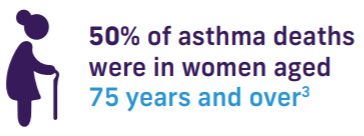
Asthma outcomes are worse for older women in Australia, who experience some of the highest rates of asthma illness and death. Women aged 75 and over account for nearly half of all asthma deaths3. Many of these deaths can be prevented with proper asthma care 8.
Asthma in older adults often presents differently. Sometimes it may appear more severe, while sometimes it is overlooked or misdiagnosed. Many older women also live with other chronic conditions. Other health concerns can complicate asthma management and make symptoms harder to recognise.
Read more about asthma in seniors
WHAT DOES “GOOD ASTHMA CONTROL” LOOK LIKE?
You’re not alone if you’re unsure. Many women push through symptoms because life is busy. Good asthma symptom control means:
- No night waking from asthma, or symptoms as soon as you wake up
- No wheeze, cough or other asthma symptoms more than two days per week
- Using your reliever only occasionally, no more than two days per week
- Being able to exercise, work and live without symptoms getting in the way
If this doesn’t sound like your week, your asthma might not be as controlled as it could be. Click below to do a quick test and find out your asthma score.
Questions About Asthma in Women
Call our free information and support service to speak with an Asthma Educator. 1800 ASTHMA (1800 278 462) or email [email protected] or book an appointment online.
References
- Australian Bureau of Statistics (ABS). Asthma [cited 2026 Feb 3]. www.abs.gov.au/statistics/health/health-conditions-and-risks/asthma/latest-release
- ABS. Causes of Death, Australia, data cubes 2024 [cited 2025 Nov 14]. www.abs.gov.au/statistics/health/causes-death/causes-death-australia/2024
- National Asthma Council Australia. Asthma Mortality Statistics 2024 [cited 2025 Nov 25]. www.nationalasthma.org.au/living-with-asthma/resources/health-professionals/infographics/asthma-mortality-statistics-2024
- Australian Institute of Health and Welfare (AIHW). Principal diagnosis data cubes. Separation statistics by principle diagnosis, Australia, 2023-24 [cited 2025 Jul 9]. www.aihw.gov.au/reports/hospitals/principal-diagnosis-data-cubes/contents/summary
- AIHW. Australian Burden of Disease Study 2024 [ cited 2026 Feb 4]. www.aihw.gov.au/reports/burden-of-disease/australian-burden-of-disease-study-2024
- AIHW. Health of children [cited 2024 Aug 30]. www.aihw.gov.au/reports/children-youth/health-of-children
- AIHW. Asthma [cited 27 Feb 2026]. https://www.aihw.gov.au/reports/chronic-respiratory-conditions/asthma
- AIHW. Deaths in Australia . Table S5.3. [cited 2025 Apr. 16]. https://www.aihw.gov.au/reports/life-expectancy-deaths/deaths-in-australia
Published: 10/03/2026